
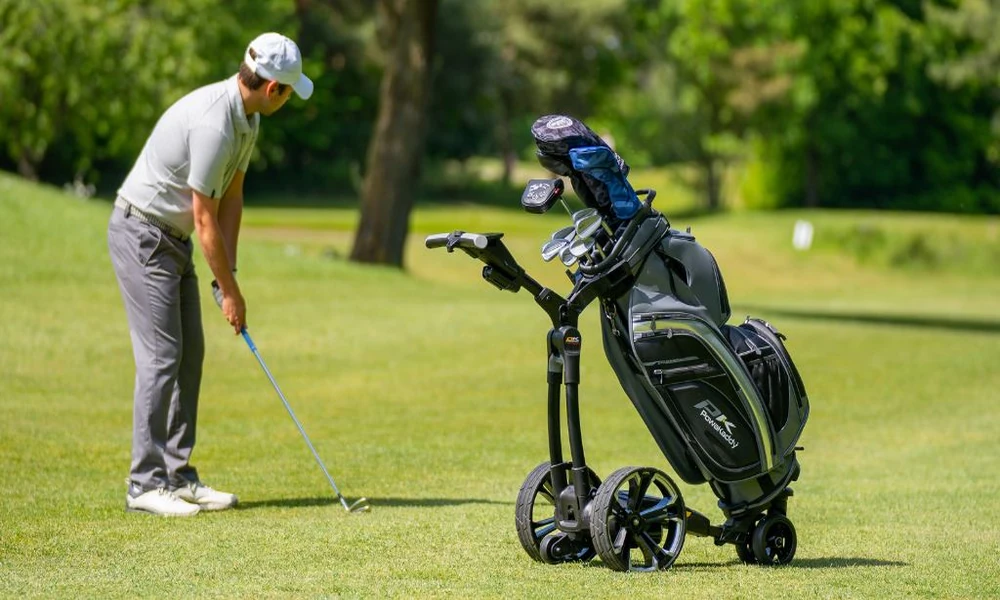

Electric golf trolleys replace the physical effort of pushing or carrying a bag across eighteen holes by using a battery-powered motor to drive the wheels forward at a controlled pace. Golfers considering a switch from push trolleys to electric models find that the working system is straightforward once its three main components are understood. Electric golf trolleys operate through a motor, a battery, and a speed controller working together, and the sections below trace how each component functions and how battery capacity translates into usable round coverage.
Trolley power system
Electric golf trolleys run on a motor and battery combination that converts stored electrical energy into wheel rotation at the speed the golfer sets. When current is passed from the battery through the speed controller to the motor terminals, the motor is situated within the rear hub or chassis of the trolley and drives the wheel directly. When a standard round of golf is played, most electric trolleys operate on brushless motors that require no maintenance and provide consistent torque on flat and uphill terrain without overheating. Battery power is directed to the motor via a controller unit that regulates how much current reaches it at any given time. Upon setting a speed, the golfer’s controller opens the circuit to match that speed, holding it steady until the setting is changed. When you slow down the speed, you narrow the current flow, which slows down the wheels. With an increase in it, the flow becomes wider, and the motor responds within fractions of a second. Due to the system’s lack of a clutch, gearbox, and physical connection between the golfer and the trolley, remote-controlled models are able to travel several metres ahead while the golfer walks alongside.
Course navigation function
Electric trolleys navigate the course through the golfer’s manual guidance at the handlebar or through remote signals when a remote handset is included. Most handlebar-operated models steer through differential wheel speed, where pressing one side of the handlebar slightly slows the corresponding wheel and causes the trolley to curve in that direction without a steering mechanism.
Important navigation features found across current electric trolley models:
- Downhill braking systems sense slope angle and apply motor resistance to prevent the trolley from rolling away on descents.
- Parking brake levers lock the rear wheels when the trolley is stationary on any terrain.
- The remote operation range typically extends to thirty to fifty metres, depending on the model.
- Obstacle detection on higher specification models stops the trolley automatically when resistance is sensed at the wheels.
Battery round capacity
Lithium batteries deliver consistent power output across their discharge cycle, meaning the trolley runs at the same speed on hole seventeen as it did on hole one, rather than slowing as the battery depletes. It is said that lead-acid batteries cost less, but they are heavier, and their voltage decreases toward the end of their discharge, resulting in slower speeds during the final holes. There is a wide variation in the coverage of an eighteen-hole lithium battery pack between eighteen and twenty-seven holes, with hilly courses requiring more energy when climbing than flat parkland courses.
Generally, battery cells should be charged every round, rather than waiting for full depletion, to protect their longevity. A full depletion usually takes four to eight hours to recharge.
How do electric golf trolleys work on the course?